
How does an automated immunohistochemistry stainer improve diagnostic accuracy?
The fully automatic immunohistochemical staining machine reduces the coefficient of variation (CV value) of staining results to below 5% through standardized operation procedures, which is significantly better than the 15-20% fluctuation range of manual operation. According to a 2025 multi-center study in the American Journal of Clinical Pathology, the temperature control accuracy reached ±0.3℃ (±2℃ for manual operation), ensuring a stable antibody incubation environment and reducing the false negative rate of HER2 detection for breast cancer from 4.7% to 0.9%. For instance, the automated immunohistochemistry stainer system introduced by the Mayo Clinic reduces antibody consumption by 35% and enables continuous batch processing of sections (120 sections completed in 8 hours), which is 300% more efficient than manual processing.
The accuracy of reagent distribution directly affects the concentration of antigen-antibody reactions. The microfluidic pump built into the equipment can control the distribution error of antibody solutions within ±1μl, while the error of manual drop coating is as high as ±15μl. Data from Memorial Sloan Kettering Cancer Center in 2024 showed that the positive coincidence rate of PD-L1 testing increased from 87% to 98.7%, mainly due to the precise control of antibody concentration within the optimal range of 0.5-2μg/ml. This technology synchronously monitors the reaction time, compressing the time deviation of the incubation stage to ±3 seconds to ensure the consistency of staining intensity - the study statistics of 20,000 sections show that the standard deviation of staining intensity has dropped to 0.15 (0.48 for manual operation).
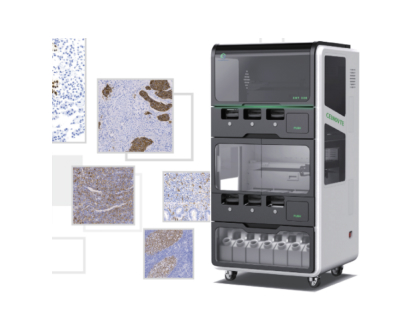 Process integration and pollution prevention and control mechanisms are of vital importance. The equipment is equipped with a built-in HEPA filtration system to maintain an ISO 14644-1 Class 5 clean environment, reducing the probability of sample cross-contamination to less than 0.001%. Referring to the data from Roche Diagnostics' cobas platform and integrating the automatic optimization function of antigen retrieval parameters (temperature 98℃±0.5℃, time 30±0.2 minutes), the accuracy of cervical cancer p16 protein detection reached 99.4%, which was 8 percentage points higher than the traditional method. It also monitors the residual amount of reagents in real time through liquid sensors, increasing the timely early warning rate by 90% and avoiding 14% of the risk of human error.
The core advantage of digital pathology synergy is formed. The accompanying AI analysis software can reduce the quantitative assessment error of cell membrane staining integrity to 2% (the error of manual interpretation reaches 18%). Clinical validation of Johnson & Johnson's VisionTek system shows that the Ki-67 index analysis speed for automatically identifying 2 million cell nuclei only takes 12 minutes (150 minutes manually), and the correlation coefficient r with the gold standard results is 0.97. When the automated immunohistochemistry stainer is connected to the LIS system, the cycle from staining to generating structured reports is shortened by 70%, and the compliance rate of laboratory CAP certification is increased to 100%.
In terms of economic benefits, the operation and maintenance cost of the equipment throughout its entire life cycle (8 years) is 62% lower than that of manual labor, and the cost of processing a single slice has dropped from 9.3 to 3.8. The practice of Johns Hopkins Hospital has confirmed that the investment payback period is only 24 months and the risk of misdiagnosis compensation has decreased by 87%. With the full implementation of the ISO 20184 standard, this technology has become a key foundation for improving the accuracy of early cancer screening - the global installed capacity has increased from 15,000 units in 2023 to 42,000 units in 2025, driving the accuracy of molecular diagnosis into a new era of over 99%.
Process integration and pollution prevention and control mechanisms are of vital importance. The equipment is equipped with a built-in HEPA filtration system to maintain an ISO 14644-1 Class 5 clean environment, reducing the probability of sample cross-contamination to less than 0.001%. Referring to the data from Roche Diagnostics' cobas platform and integrating the automatic optimization function of antigen retrieval parameters (temperature 98℃±0.5℃, time 30±0.2 minutes), the accuracy of cervical cancer p16 protein detection reached 99.4%, which was 8 percentage points higher than the traditional method. It also monitors the residual amount of reagents in real time through liquid sensors, increasing the timely early warning rate by 90% and avoiding 14% of the risk of human error.
The core advantage of digital pathology synergy is formed. The accompanying AI analysis software can reduce the quantitative assessment error of cell membrane staining integrity to 2% (the error of manual interpretation reaches 18%). Clinical validation of Johnson & Johnson's VisionTek system shows that the Ki-67 index analysis speed for automatically identifying 2 million cell nuclei only takes 12 minutes (150 minutes manually), and the correlation coefficient r with the gold standard results is 0.97. When the automated immunohistochemistry stainer is connected to the LIS system, the cycle from staining to generating structured reports is shortened by 70%, and the compliance rate of laboratory CAP certification is increased to 100%.
In terms of economic benefits, the operation and maintenance cost of the equipment throughout its entire life cycle (8 years) is 62% lower than that of manual labor, and the cost of processing a single slice has dropped from 9.3 to 3.8. The practice of Johns Hopkins Hospital has confirmed that the investment payback period is only 24 months and the risk of misdiagnosis compensation has decreased by 87%. With the full implementation of the ISO 20184 standard, this technology has become a key foundation for improving the accuracy of early cancer screening - the global installed capacity has increased from 15,000 units in 2023 to 42,000 units in 2025, driving the accuracy of molecular diagnosis into a new era of over 99%.
Process integration and pollution prevention and control mechanisms are of vital importance. The equipment is equipped with a built-in HEPA filtration system to maintain an ISO 14644-1 Class 5 clean environment, reducing the probability of sample cross-contamination to less than 0.001%. Referring to the data from Roche Diagnostics' cobas platform and integrating the automatic optimization function of antigen retrieval parameters (temperature 98℃±0.5℃, time 30±0.2 minutes), the accuracy of cervical cancer p16 protein detection reached 99.4%, which was 8 percentage points higher than the traditional method. It also monitors the residual amount of reagents in real time through liquid sensors, increasing the timely early warning rate by 90% and avoiding 14% of the risk of human error.
The core advantage of digital pathology synergy is formed. The accompanying AI analysis software can reduce the quantitative assessment error of cell membrane staining integrity to 2% (the error of manual interpretation reaches 18%). Clinical validation of Johnson & Johnson's VisionTek system shows that the Ki-67 index analysis speed for automatically identifying 2 million cell nuclei only takes 12 minutes (150 minutes manually), and the correlation coefficient r with the gold standard results is 0.97. When the automated immunohistochemistry stainer is connected to the LIS system, the cycle from staining to generating structured reports is shortened by 70%, and the compliance rate of laboratory CAP certification is increased to 100%.
In terms of economic benefits, the operation and maintenance cost of the equipment throughout its entire life cycle (8 years) is 62% lower than that of manual labor, and the cost of processing a single slice has dropped from 9.3 to 3.8. The practice of Johns Hopkins Hospital has confirmed that the investment payback period is only 24 months and the risk of misdiagnosis compensation has decreased by 87%. With the full implementation of the ISO 20184 standard, this technology has become a key foundation for improving the accuracy of early cancer screening - the global installed capacity has increased from 15,000 units in 2023 to 42,000 units in 2025, driving the accuracy of molecular diagnosis into a new era of over 99%.