
Why Custom Perfume Samples Change: A Buyer's Checklist for a Men's Line
Most sample changes are not about the scent idea; they are about a variable that moved between batches — resting time, fragrance dosage, the alcohol lot, a raw-material batch, the pump, or the way the bottle was stored. A buyer who compares the records before comparing the smells finds the cause quickly, while a buyer who reacts to the difference burns weeks of sampling rounds. Treat the first changed sample as a data point, not a crisis: the second sample should test one hypothesis, not apologize for the first.
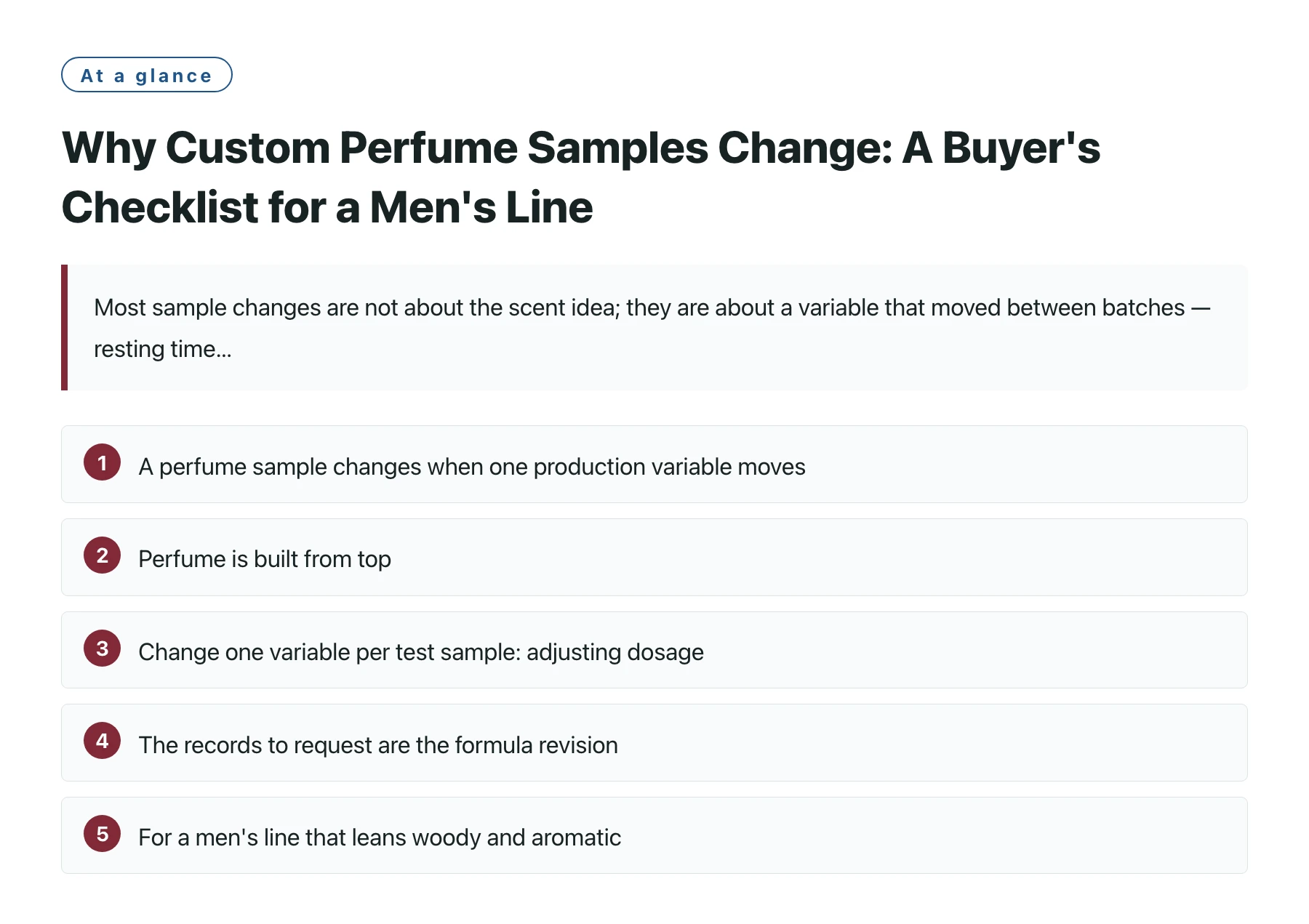
Key takeawaysA perfume sample changes when one production variable moves; the usual suspects are resting time, fragrance dosage, alcohol and water levels, raw-material lots, packaging and storage history. · Perfume is built from top, middle and base materials that behave differently over time, so the same liquid can smell different at different minutes; comparisons need time points, not single sniffs. · Change one variable per test sample: adjusting dosage, alcohol and materials in the same revision makes the cause impossible to isolate. · The records to request are the formula revision, concentrate code and strength, dosage percentage, alcohol lot, dilution and resting dates, filtration status and packaging codes; without them the next round will repeat the same confusion. · For a men's line that leans woody and aromatic, the dry-down is where stability shows first, so rejection decisions belong on timed evaluations rather than on the first fifteen minutes.
A common scene in a men's line project: sample one has a clean citrus opening and a woody dry-down, the team approves it, and sample two of the same project arrives softer and slightly sweeter. The usual assumption is that the factory changed something, or that natural variation is quietly hiding a problem. In most cases neither is true — a defined variable moved, and nobody recorded which one.
The men's angle makes the question sharper. Profiles that lean woody, leathery or aromatic carry most of their identity in the base notes, so the dry-down is where a difference matters most — and the dry-down is exactly the part that shifts with dosage, resting time and storage.
This article is a checklist for comparing samples the way a development team does: which variables move, how to run a comparison that proves something, and which records to demand before the next sampling round.
The variables that move a sample
A sample is a bundle of variables, and the bundle changed between round one and round two. Six of them account for nearly every 'it smells different' report: resting time, fragrance dosage, alcohol and water, raw-material lots, packaging, and storage or shipping history. The fastest diagnostic is to ask which of these six changed, and what the record says.
Resting time
A freshly diluted sample and a rested sample are different liquids, because a perfume is composed of materials that behave differently as they settle and evaporate at different rates [1]. A fresh sample often shows a sharper alcohol opening and less settled transitions between notes; a rested sample can be rounder. Compare samples at matching ages — never a two-day-old one against a fourteen-day-old one — or you are comparing resting time, not scent.
Fragrance dosage
Dosage is the weight of concentrate as a percentage of the finished batch, and it changes more than strength. Raising it can push woody, musky, amber or sweet materials forward and alter the whole balance; lowering it can make the alcohol more noticeable and shorten the dry-down. Two samples both labelled 16% are not necessarily equal if the concentrate strength differs, so the code and strength belong on the sample sheet.
Alcohol and water
The carrier matters in the first minutes of a wearing. Purity, water content, the denaturing system and the lot can each shift the opening, and a cold shipment can make a sample temporarily cloudy. Before blaming the perfume, rule out the carrier: compare the two alcohol lots on blank blotters, and let a cold bottle return to room temperature before you open it.
Natural materials
Ingredients from plants carry their origin with them — growing area, harvest season and extraction method all change the odor within a tolerance. A bergamot lot can smell greener and a patchouli lot drier without the formula changing. Natural variation has limits: it does not explain a missing major note or a new off-odor. And when a material is substituted, the change can also alter allergen information and permitted use levels, which is why fragrance materials are reviewed against safe-use standards before they are approved for a product category [2].
Packaging and storage
The pump decides how much liquid reaches the skin, so two identical perfumes in different pumps compare differently. Heat, light and air exposure change color, clarity and odor over time, and gaskets or seals can contribute a plastic or rubber note. A sample that smells different after shipping is often a packaging or temperature story, not a formula story.
Change you notice, variable to check
| What you notice | Variable to check first | Quick test |
|---|---|---|
| Sharper alcohol opening | Age of the dilution, alcohol lot, pump output | Compare blank alcohol and a timed blotter |
| Weaker dry-down | Dosage, base materials, packaging | Timed blotter at four and eight hours |
| Sweeter or heavier scent | Dosage, vanilla or amber lot, missing fresh notes | Compare concentrate code and weighed amounts |
| Plastic or rubber smell | Pump, gasket, seal, coating | Same liquid in a control bottle |
| Cloudiness or sediment | Water level, temperature history, filtration | Let it return to room temperature, then review records |
| Whole structure changed | Formula revision, substitution, dilution error | Review the batch record and make a reproduction batch |
Read the last row first. A wholesale change in structure points to a record problem — a wrong revision, a substituted material or a weighing error — and no amount of sniffing will fix it.
Running a comparison that proves something
Agree the test before the visit
Set the blotter type, the amount of liquid, the room and the schedule — opening, fifteen minutes, one hour, four hours, eight hours and the next day — and score one defined feature at each point. Without a fixed schedule, 'it is different' is the only conclusion you will reach.
Change one variable per round
A revision that asks for a fresher opening, a denser heart and a longer dry-down at the same time gives the laboratory contradictory instructions. Pick one or two targets, and change one production variable per test sample, or the next improved sample will not tell you why it improved.
Keep a reference, not a memory
Seal one sample from the approved batch with the date and batch number, and keep a separate working bottle for routine comparison. Before opening a received shipment, check the seal and fill level, photograph anything unusual, and let a very hot or cold bottle return to a stable room temperature first.
Write observations with a time
'Strong in the first five minutes' and 'still noticeable after eight hours' are different statements, and only the second one survives a dispute. Use blind codes so that expectations do not do the smelling for you.
Records to request before the next round
- Formula and revisionThe exact code and finished-product revision for both samples, in writing.
- Concentrate specificationCode, strength and lot — confirm the carrier is identical between rounds.
- Dosage and actual weightsWhat was weighed for concentrate, alcohol, water and the total batch, not just the target.
- The four datesConcentrate completion, dilution, filtration and filling, plus the resting schedule used.
- Material and packaging lotsRaw-material lot records and the bottle, pump and gasket codes from each sample.
- Deviation notesAny substitution or adjustment made without approval, and its review status.
If a supplier explains every difference with 'natural variation' but cannot show the records, stop ordering samples until the documentation exists. An approved sample is a contract about repeatability, and repeatability lives in documents, not in explanations.
What the men's line changes about the comparison
A men's line that leans woody, leathery or aromatic carries its identity in the base, so judge it on the timed dry-down rather than the opening. A fresh sample of such a formula can smell sharper and more alcohol-forward than the same formula after resting; if you compare at mismatched ages, you will reject a good product and approve a lucky one.
Revision language matters here too. 'Softer' is vague; 'the opening is too sharp for the first fifteen minutes' is a target the laboratory can work with. And because the profile leans on the base, ask specifically about the four- and eight-hour points when you evaluate the next round.
The mechanics behind all of this are worth reading once; what changes a perfume sample over time on a manufacturer's site walks through each variable and the records that pin it down, which is a useful reference when a supplier's explanation sounds too smooth.
One more check before you approve: in the EU, fragrance allergens must be shown on the label when they exceed set thresholds, so a dosage change or a material substitution can force a label update even when the scent seems identical [3].
When the project moves from 'make me a scent' to a real brief, work with a partner that handles development with the same record discipline — for a men's line, a manufacturer that builds custom scents that keeps sample history and batch records is worth more than a lower quote.
And check the public face of the shortlist before the first call: a manufacturer such as Xuelei Fragrance publishes its scope openly, which makes the due diligence concrete rather than a leap of faith.
Sources
- Wikipedia: Perfume —— An encyclopaedic overview of perfume covering definitions, history, the note structure of a fragrance and concentration terminology (background reference only).
- IFRA: Safe Use and Fragrance Science —— IFRA's explanation of how fragrance materials are scientifically assessed for safe use and how those conclusions are applied by the industry.
- European Commission: Cosmetic Products — Specific Topics —— EU pages covering specific cosmetics topics such as product claims, nanomaterials and animal-testing rules.
Frequently asked questions
Why does my second sample smell different from the approved first one?
The most likely causes are resting time, fragrance dosage, the alcohol lot, a raw-material batch, the pump or storage history. Compare the records for both samples before comparing the smells, and change one variable per test round.
How long should a fresh sample rest before I evaluate it?
There is no universal resting period; it depends on the formula and the process. What matters is comparing samples at matching ages, so record the dilution, filtration and filling dates and use the same schedule for every round.
Can I ask for a stronger version without losing the scent balance?
Yes, if you say what 'stronger' means — a brighter opening, more projection in the first hour, or a longer dry-down. One or two clear targets per revision keep the laboratory from juggling contradictory instructions.
Does natural material variation excuse any difference?
Only differences inside the approved range. A missing major note, a new off-odor, a large change in sweetness or a clear loss of dry-down needs investigation and records, not an explanation.
What records should I keep on my side?
A sealed reference sample with the date and batch number, the approval email with the formula code, dosage and dates, timed comparison notes, and a change log of every revision request you made.