
Using a Mining Profit Calculator With Merged Mining Included
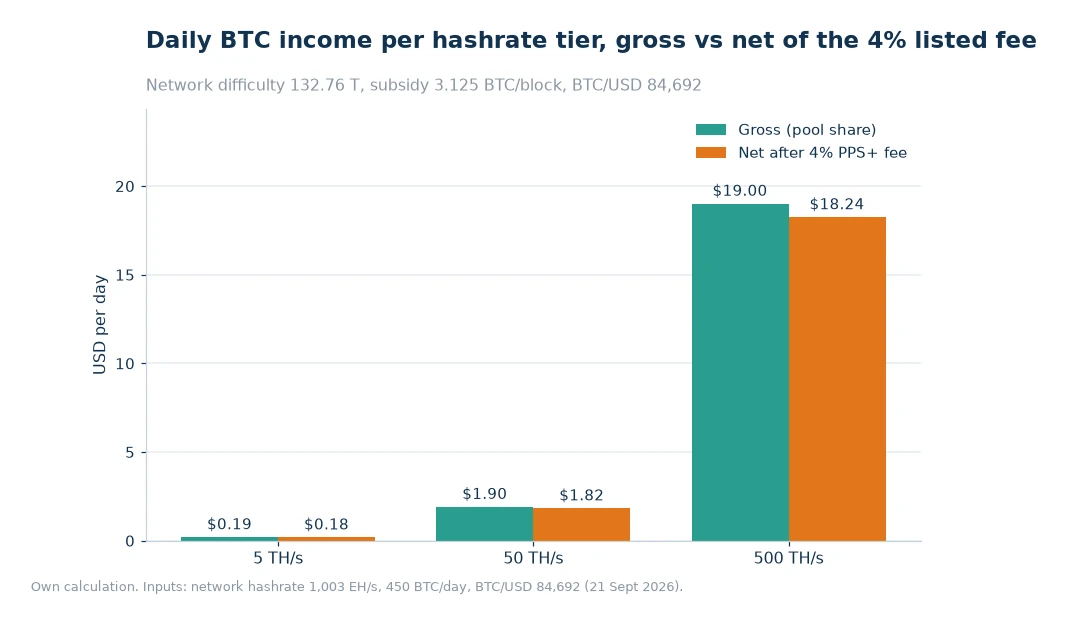
A mining profit calculator converts four inputs — coin price, difficulty, fee rate and effective hashrate — into an estimated daily income, and the version worth using also counts merged-mining output, which most third-party tools ignore. The gap is easy to see in the arithmetic: at a network hashrate of about 1,003 EH/s and 450 BTC issued per day, 5 TH/s produces about 0.00000224 BTC daily, roughly $0.19 at a BTC price of $84,692, while 500 TH/s produces about $19.00 gross. Getting that estimate right matters because the number decides whether hardware gets switched on at all.

Key takeaways
- Gross daily BTC equals your hashrate divided by network hashrate, multiplied by 450 BTC — and then by one minus the listed fee that applies to the component being paid.
- On PPS+, the listed 4% attaches to the PPS-settled block-reward component and the listed 2% to the transaction-fee component; the two do not add up to a flat 6% on income.
- Merged mining changes the estimate rather than the hardware: one machine can secure a parent chain and an auxiliary chain at the same time, and a calculator that ignores the auxiliary output understates the result.
- Cost per day, not hashrate, decides profitability: 10 PH/s on 20 J/TH hardware draws roughly 200 kW, or about $288 of electricity per day at $0.06/kWh against roughly $380 gross.
Definitions first
Four terms do most of the work in any estimate.
Hashrate is work per second — TH/s, PH/s, EH/s. Effective hashrate is what your machines actually deliver to the pool over a period, after rejections and downtime, and it is always lower than the number on the box. Difficulty is the network's target setter: it resets the work needed per share so blocks keep arriving about every ten minutes, and at 132.76 T it is the denominator that turns your hashrate into BTC. Block subsidy is the reward attached to each block — currently 3.125 BTC, which with 144 blocks a day totals 450 BTC issued daily across the whole network.
Merged mining is the mechanism that lets a machine work on two chains at once. A miner securing LTC can also receive DOGE, because the auxiliary chain accepts work proven on the parent chain. There is no extra electricity cost for the second chain, which is exactly why leaving it out of an estimate is a real error rather than a rounding one.
Finally, the fee. A payout has a block-reward component and a transaction-fee component, and the listed rates differ by which one is being settled — the fee breakdown published by the pool is worth reading before you type a percentage into a spreadsheet.[1]
| Input | Effect on the estimate | Where to get the real value |
|---|---|---|
| Coin price | Scales the dollar result directly; no effect on the BTC figure | A market feed, read on the same date as the difficulty figure |
| Network difficulty | Sets how many BTC a given hashrate earns | On-chain difficulty charts, checked against the next adjustment estimate |
| Fee rate | Applies only to the component being paid under the chosen method | The pool's published fee schedule and its breakdown per component |
| Effective hashrate | Cuts the result in proportion to downtime and rejected shares | Your own pool dashboard, averaged over at least a week |
| Merged-mining output | Adds a second revenue stream that no extra power is spent on | A calculator that models the auxiliary chain, not just the primary one |
| Electricity price and J/TH | Converts gross income into margin or loss | Your tariff and the machine's nameplate efficiency, both measured |
Run those six inputs through a tool that accepts them and you have an estimate you can defend. The ViaBTC Mining Calculator takes coin price, difficulty, fee rate and effective hashrate, and includes merged-mining output in the result — which is the specific gap that makes many estimates come out low on chains such as LTC with its auxiliary DOGE reward.
The trade-off nobody prices
Most hardware comparisons price hashrate and ignore the two things that change weekly.
The first is difficulty drift. The reading used throughout this article is 132.76 T with an estimated next change of about -2.12%, but the direction of that number is not a promise and small moves are routine. An estimate built on a single day's difficulty is a snapshot; a decision built on it should assume the number moves in the unfavourable direction at some point.
The second is payout variance. Switching from PPS+ to PPLNS changes the listed fee that applies — 2% on block rewards and transaction fees together instead of 4% on the block-reward component — and it changes who carries pool luck. It does not change your expected share of network hashrate. Miners who price only the fee rate and never the variance tend to discover the difference during their first quiet week.
There is a third, quieter trade-off: capital efficiency versus operating efficiency. Two machines can deliver the same terahash with very different joules per terahash, and one can deliver far more terahash at a higher watt-per-terahash. Only the second number compounds daily. Whether a specific ASIC still covers its running cost at the current price and difficulty is exactly what a live profitability ranking answers[2], and it should be read next to the tariff rather than instead of it.
Example with two setups
Setup A is a single 5 TH/s machine on a residential circuit. Setup B is a 50 TH/s rack of the same generation hardware. Both are pointed at a PPS+ pool at current difficulty, and both estimates use BTC/USD 84,692.
- Setup A, 5 TH/s. Daily output 0.00000224 BTC, about $0.19 gross and roughly $0.18 after the listed 4% on the block-reward component. Its electricity bill is small, which is why small rigs survive on cheap power.
- Setup B, 50 TH/s. Daily output 0.0000224 BTC, about $1.90 gross and roughly $1.82 net. Ten times the hashrate, ten times the income, ten times the heat.
Take the same arithmetic to 500 TH/s and the figure is about 0.000224 BTC per day, roughly $19.00 gross and about $18.24 after the same fee, year-round. Notice what does not appear anywhere in that sequence: pool luck. The estimate assumes the machine submits shares continuously, and merged mining adds its auxiliary output on top of exactly these figures rather than replacing them.
Now price the downside. A machine that stops submitting shares does not stop drawing power, and at farm scale the gap between gross and net stops being theoretical. A 10 PH/s installation on 20 J/TH hardware consumes about 200 kW — 4,800 kWh a day, roughly $288 at $0.06/kWh — against about $380 of gross daily income at current difficulty. That roughly $92 daily spread is what pays for everything else, and it is the number a calculator's output should be compared against before any purchase decision.
Practical next steps
- Compute gross before net. Hashrate divided by network hashrate, times 450 BTC per day. If that figure does not cover your electricity at the speed your hardware runs, no fee structure will rescue the setup.
- Apply the fee to the right component. Read the fee schedule rather than assuming a single blended percentage; the listed 4% and 2% attach to different parts of a payout.
- Model the auxiliary chain. If the machine can merged-mine, include that revenue — it is the part third-party calculators usually miss.
- Re-run the estimate monthly. Difficulty and price both move. A calculator result is a decision aid for this month, not a fixed property of a machine.
- Verify with real credits. Compare the estimate against a week of actual payouts from the pool statistics view, and treat a persistent shortfall as a hashrate problem rather than a fee problem.
- Check the payment rail's cost. Zero-fee mining payouts and an integrated multi-currency wallet with auto conversion remove transfer steps, which matters more on small balances than a fraction of a percentage point on the fee. The PPS+ fee schedule is the place to confirm what currently applies.
Frequently asked questions
Is a bigger pool always better?
Size reduces payout variance but also concentrates hashrate. What matters more is fee structure, uptime, latency and payout cadence.
What happens if my miner goes offline?
Shares stop, so expected income stops with them. Alerts and a dashboard that shows per-worker hashrate shorten the gap between a failure and a fix.
Why does the calculator ask for a fee rate if the pool publishes one?
Because the rate applies to specific components, and because effective hashrate and pool choice change what is actually settled. Entering the listed rate against your own measured hashrate keeps the estimate comparable across options.
Can merged mining double my income?
No. The auxiliary chain adds a second reward stream from work the machine is already doing, but its size depends on that chain's own difficulty and price relative to the parent chain. Treat it as a meaningful addition, not a multiplier.
Estimate first, buy second
Write the four core inputs on one line — hashrate, difficulty, fee rate, coin price — and run the arithmetic before you commit capital. Then check the result against your electricity cost per day and against a week of real credits from an actual pool, because that is where downtime, latency and rejected shares show up. Follow the pool's setup documentation when you point hardware at a new chain[3], and re-run the estimate whenever difficulty or price moves. A calculator that includes merged-mining output gives you one number fewer to guess at.
Data and sources: the component split of the listed fees comes from the fee-breakdown documentation[1]; network difficulty (132.76 T), network hashrate (about 1,003 EH/s), the 3.125 BTC block subsidy and BTC/USD 84,692 were read on 21 September 2026; hardware comparisons come from the miner profitability ranking[2] and setup instructions from the mining guide[3]. The merged-mining treatment described here matches the ViaBTC estimation tool. All income figures are own calculations from those inputs and change as difficulty and price move.